Detailed Record
Fraser's Magazine for Town and Country
vol 1 no 1, Feb 1830 - vol 80 no 140, Dec 1869

then: Fraser's Magazine. vol 1 no 1 [2s], Jan 1870 - vol 53 [vol 26?] no 453, Oct 1882
then: Longman's Magazine. vol 1, Nov 1882 - 1905//
then: Longman's Magazine. vol 1, Nov 1882 - 1905//
Dublin,Dublin (1830)
Edinburgh,Midlothian
London,Middlesex (1882)
Editor:
William Allingham (sub-editor 1870; Sep 1874 - Jun 1879)
George Webbe Dasent (Sep 1871)
James Fraser
James Anthony Froude (Nov 1860 - Aug 1874)
John Abraham Heraud (assistant editor 1830 - 1833, Sep 1871)
Charles James Longman (Feb 1881 - Oct 1882)
William Maginn (Feb 1830 - 1842)
Francis Sylvester Majoney (Oct? 1836 - Dec 1837?)
George William Nickisson (1840s)
John William Parker ((Jr) (Jul 1847 - Oct 1860))
William Makepeace Thackeray
John Tulloch (Jul 1879 - Jan 1881)
George Webbe Dasent (Sep 1871)
James Fraser
James Anthony Froude (Nov 1860 - Aug 1874)
John Abraham Heraud (assistant editor 1830 - 1833, Sep 1871)
Charles James Longman (Feb 1881 - Oct 1882)
William Maginn (Feb 1830 - 1842)
Francis Sylvester Majoney (Oct? 1836 - Dec 1837?)
George William Nickisson (1840s)
John William Parker ((Jr) (Jul 1847 - Oct 1860))
William Makepeace Thackeray
John Tulloch (Jul 1879 - Jan 1881)
Proprietor:
Hugh Fraser
James Fraser (Feb 1830 - c.Dec 1841)
John William Parker and Son (Jul 1847 - Dec 1860)
Longman, Green, Longman, Roberts and Green (Nov 1863 - Jun 1865)
Longmans, Green and Co (Jul 1865 - Oct 1882)
George William Nickisson (Jan 1842 - Jun 1847)
J.W. Parker
Parker, Son and Bourn (Jan 1861 - Oct 1863)
Maginn Westmacott
James Fraser (Feb 1830 - c.Dec 1841)
John William Parker and Son (Jul 1847 - Dec 1860)
Longman, Green, Longman, Roberts and Green (Nov 1863 - Jun 1865)
Longmans, Green and Co (Jul 1865 - Oct 1882)
George William Nickisson (Jan 1842 - Jun 1847)
J.W. Parker
Parker, Son and Bourn (Jan 1861 - Oct 1863)
Maginn Westmacott
Publisher:
John Boyd (Edinburgh)
James Fraser (London 1830 - Dec 1841)
Grant and Co (Dublin Feb 1830 - Dec 1841)
John William Parker and Son (Jul 1847 - Dec 1860)
Longman, Green, Longman, Roberts and Green (Nov 1863 - Jun 1865)
Longmans, Green and Co (Jul 1865 - Apr 1883)
George William Nickison (Jan 1842 - Jun 1847)
John William Parker
Parker, Son and Bourn (Jan 1861 - Oct 1863)
Fraser Smith
James Fraser (London 1830 - Dec 1841)
Grant and Co (Dublin Feb 1830 - Dec 1841)
John William Parker and Son (Jul 1847 - Dec 1860)
Longman, Green, Longman, Roberts and Green (Nov 1863 - Jun 1865)
Longmans, Green and Co (Jul 1865 - Apr 1883)
George William Nickison (Jan 1842 - Jun 1847)
John William Parker
Parker, Son and Bourn (Jan 1861 - Oct 1863)
Fraser Smith
Printer:
John Boyd (Edinburgh)
James Fraser (London 1830 - Dec 1841)
Grant and Co (Dublin Feb 1830 - Dec 1841)
Gunnel and Shearman (London 1830)
Moyes (1835)
John William Parker
Spottiswoode and Co (London 1882)
James Fraser (London 1830 - Dec 1841)
Grant and Co (Dublin Feb 1830 - Dec 1841)
Gunnel and Shearman (London 1830)
Moyes (1835)
John William Parker
Spottiswoode and Co (London 1882)
Contributors:
Juniper Agate (Thomas Spencer Baynes)
William Harrison Ainsworth
Alexander Allardyce
Grant Allen (1883)
William Allingham (Nov 1862 - Nov 1863, 1874)
C.J. Apperley ("Nimrod")
Arthur Arnold (1878)
Matthew Arnold (1855)
Thomas James Arnold
W.D. Arnold
William Guy Augustus
Sarah Taylor Austin
Charles David Badham
S. Baring-Gould
William Barnes
Peter Bayne
Dorothea Beale ("A Utopian", 1866)
Robert Bell
Andrew Kennedy Hutchison Boyd Bradley (Rev. 1862)
George Brimley
William John Broderip
Egyrton Brydges (1834)
Henry Thomas Buckle (1858)
Edward George Earle Bulwer-Lytton (Baron Lytton)
Selina Bunbury (1836-1850)
Selina Bunbury
J.M. Capes (1860)
Thomas Carlyle (1833 - 1844)
Charles Cornwallis Chesney
William George Clark
Agnes Mary Clerke
Edward Clodd
Francis Power Cobbe (1862)
Coleridge
George Combe
Condy (1833)
C.A. Vansittart Conybeare (1879)
Barry Cornwall (Bryan Procter)
Caroline Francis Cornwallis
Edward Byles Cowell
Dinah Mulock Craik
Crofton Croker
Thomas Crofton Croker (1845)
Thomas Croskery (D. D.)
George Cruikshank
Delta Cunningham (David Macbeth Moir)
Peter Cunningham
Sister Mare Francis Cusack (1874)
Charles Dickens (Oliver Twist and Nicholas Nickleby)
Benjamin Disraeli
John William Donaldson (D.D.)
William Bodham Donne
Harriet Downing
George Eliot (Mary Ann Evans, née Cross)
T.H.S. Escott
Charles John Evans (1856)
Alexander Falconer
F.W. Farrar (1870)
Percy Fitzgerald
W. Forsyth (1857)
William Forsyth
George Henry Francis
Alexander Tilloch Galt (Sir)
Francis Galton ("An Old Boy", 1874, 1875)
Richard Garnett
Elizabeth Gaskell
George Robert Gleig
Robert Gleig
Charles Wycliffe Goodwin
Edmund Gosse
W.R. Greg (Sep 1868)
Agnes C. (Mrs.) Hall
Arthur Henry Hallam
Edward Bruce Hamley (Sir) 1824 - 1893)
Ephraim Hardcastle (William Henry Pyne)
Ernest A. Hart
Abraham Hayward
William Maunsell Hennessy
James Hogg
Edward Holmes
William Hopkins
Richard Henry Horne (1882)
T.C. Horsfall (1880)
John Pyke Hullah
James Henry Leigh Hunt
Richard Holt Hutton (May 1880)
Edward Irving (Rev.)
Henry Jackson
John Cody Jeaffreson (1855)
Richard Jefferies
William Jerdan
Bennet George Johns (Rev.)
David Deady Keane
John Keats
John Mitchell Kemble
Edward Vaughan Hyde Kenealy
Richard John King
Charles Kingsley (pseudonym 'Parson Lot', 1819 - 1875)
Henry Kingsley
George Kinsley
Isa (Mrs.) Knox
L.E.L. (Laetitia Landon, 1830)
Robert Lamb (Oct 1857)
Walter Savage Landor
John Lang
George Alfred Lawrence (1827 - 1876)
W.H. Leeds (1843)
Thomas Edward Cliffe Leslie (1868)
G.H. Lewes (1847)
George Henry Lewes
George Cornwall Lewis (Sir)
Eliza Lynn Linton
Lockhart
William Longman (1875)
John Malcolm Forbes Ludlaw
James Macdonnell
Thomas Macknight
Daniel Maclise (ill. 1838)
David Maclise
Robert MacNish (surgeon)
William Maginn (L.L.D.)
Francis Mahony (pseudo Father Prout)
Edward Mallalieu
Theodore Martin (Sir)
David Masson
James McCoan
Stuart McCulloch
George John Whyte Melville
George Meredith
John Stuart Mill
John Mitchell (1846)
David Moir (surgeon)
Henry J. Moncraft
James Moncrieff
Frederick Maximilian Müller
Arthur J. Munby (1870)
Fancis Stack Murphy
Sergeant Francis Murphy
Francis William Newman (1867)
Margaret Oliphant (1882)
John Ormsby
Frederick Apthorp Paley
James Payn (1883)
George S.B. Powell (Sir)
Thomas Powell (Apr 1830)
R.A. Proctor
Morgan Rattler (Sir John Thomas Banks)
Cyrus Redding
E.S. Roscoe
William Michael Rossetti (Nov 1861)
John Ruskin
P.B. Shelley
Edith Simcox (pseudo "H. Lawrenny")
John Palgrave Simpson
William Simpson
John Skelton (1858, Nov 1869)
Robert Southey
Leslie Stephen (Sir)
A. Stirling-Maxwell (1878)
William Stirling-Maxwell
Isaac Taylor
William Makepeace Thackeray (pseudonyms "Yellowplush", "Fitz-boodle", "Michael Angelo Tidmarsh")
Katherine Thomson ("A Man Middle-Aged")
H.M. Trollope
John Tullock
Robert Alfred Vaughan
Henry E. Watts
Charles Wells
Carlyle West
William Whewell
George John Whyte-Melville (1821 - 1878)
John Wilks
Robert Aris Willmott
William Wilson
John George Wood
Thomas Wright
Foster Barham Zincke
William Harrison Ainsworth
Alexander Allardyce
Grant Allen (1883)
William Allingham (Nov 1862 - Nov 1863, 1874)
C.J. Apperley ("Nimrod")
Arthur Arnold (1878)
Matthew Arnold (1855)
Thomas James Arnold
W.D. Arnold
William Guy Augustus
Sarah Taylor Austin
Charles David Badham
S. Baring-Gould
William Barnes
Peter Bayne
Dorothea Beale ("A Utopian", 1866)
Robert Bell
Andrew Kennedy Hutchison Boyd Bradley (Rev. 1862)
George Brimley
William John Broderip
Egyrton Brydges (1834)
Henry Thomas Buckle (1858)
Edward George Earle Bulwer-Lytton (Baron Lytton)
Selina Bunbury (1836-1850)
Selina Bunbury
J.M. Capes (1860)
Thomas Carlyle (1833 - 1844)
Charles Cornwallis Chesney
William George Clark
Agnes Mary Clerke
Edward Clodd
Francis Power Cobbe (1862)
Coleridge
George Combe
Condy (1833)
C.A. Vansittart Conybeare (1879)
Barry Cornwall (Bryan Procter)
Caroline Francis Cornwallis
Edward Byles Cowell
Dinah Mulock Craik
Crofton Croker
Thomas Crofton Croker (1845)
Thomas Croskery (D. D.)
George Cruikshank
Delta Cunningham (David Macbeth Moir)
Peter Cunningham
Sister Mare Francis Cusack (1874)
Charles Dickens (Oliver Twist and Nicholas Nickleby)
Benjamin Disraeli
John William Donaldson (D.D.)
William Bodham Donne
Harriet Downing
George Eliot (Mary Ann Evans, née Cross)
T.H.S. Escott
Charles John Evans (1856)
Alexander Falconer
F.W. Farrar (1870)
Percy Fitzgerald
W. Forsyth (1857)
William Forsyth
George Henry Francis
Alexander Tilloch Galt (Sir)
Francis Galton ("An Old Boy", 1874, 1875)
Richard Garnett
Elizabeth Gaskell
George Robert Gleig
Robert Gleig
Charles Wycliffe Goodwin
Edmund Gosse
W.R. Greg (Sep 1868)
Agnes C. (Mrs.) Hall
Arthur Henry Hallam
Edward Bruce Hamley (Sir) 1824 - 1893)
Ephraim Hardcastle (William Henry Pyne)
Ernest A. Hart
Abraham Hayward
William Maunsell Hennessy
James Hogg
Edward Holmes
William Hopkins
Richard Henry Horne (1882)
T.C. Horsfall (1880)
John Pyke Hullah
James Henry Leigh Hunt
Richard Holt Hutton (May 1880)
Edward Irving (Rev.)
Henry Jackson
John Cody Jeaffreson (1855)
Richard Jefferies
William Jerdan
Bennet George Johns (Rev.)
David Deady Keane
John Keats
John Mitchell Kemble
Edward Vaughan Hyde Kenealy
Richard John King
Charles Kingsley (pseudonym 'Parson Lot', 1819 - 1875)
Henry Kingsley
George Kinsley
Isa (Mrs.) Knox
L.E.L. (Laetitia Landon, 1830)
Robert Lamb (Oct 1857)
Walter Savage Landor
John Lang
George Alfred Lawrence (1827 - 1876)
W.H. Leeds (1843)
Thomas Edward Cliffe Leslie (1868)
G.H. Lewes (1847)
George Henry Lewes
George Cornwall Lewis (Sir)
Eliza Lynn Linton
Lockhart
William Longman (1875)
John Malcolm Forbes Ludlaw
James Macdonnell
Thomas Macknight
Daniel Maclise (ill. 1838)
David Maclise
Robert MacNish (surgeon)
William Maginn (L.L.D.)
Francis Mahony (pseudo Father Prout)
Edward Mallalieu
Theodore Martin (Sir)
David Masson
James McCoan
Stuart McCulloch
George John Whyte Melville
George Meredith
John Stuart Mill
John Mitchell (1846)
David Moir (surgeon)
Henry J. Moncraft
James Moncrieff
Frederick Maximilian Müller
Arthur J. Munby (1870)
Fancis Stack Murphy
Sergeant Francis Murphy
Francis William Newman (1867)
Margaret Oliphant (1882)
John Ormsby
Frederick Apthorp Paley
James Payn (1883)
George S.B. Powell (Sir)
Thomas Powell (Apr 1830)
R.A. Proctor
Morgan Rattler (Sir John Thomas Banks)
Cyrus Redding
E.S. Roscoe
William Michael Rossetti (Nov 1861)
John Ruskin
P.B. Shelley
Edith Simcox (pseudo "H. Lawrenny")
John Palgrave Simpson
William Simpson
John Skelton (1858, Nov 1869)
Robert Southey
Leslie Stephen (Sir)
A. Stirling-Maxwell (1878)
William Stirling-Maxwell
Isaac Taylor
William Makepeace Thackeray (pseudonyms "Yellowplush", "Fitz-boodle", "Michael Angelo Tidmarsh")
Katherine Thomson ("A Man Middle-Aged")
H.M. Trollope
John Tullock
Robert Alfred Vaughan
Henry E. Watts
Charles Wells
Carlyle West
William Whewell
George John Whyte-Melville (1821 - 1878)
John Wilks
Robert Aris Willmott
William Wilson
John George Wood
Thomas Wright
Foster Barham Zincke
Names:
John Thomas Banks (Sir)
Thomas Spencer Baynes
David Brewster (Sir scientist)
Egerton Brydges (Sir antiquarian)
Samuel Taylor Coleridge
Mary Ann Cross
Mary Ann Evans
Hugh Fraser (James Fraser)
Theodore Hook
William Jerdan
John Gibson Lockhart
Francis Mahony (pseudo Father Prout)
David Macbeth Moir
Bryan Procter
William Henry Pyne
Edith Jemima Simcox
Robert Southey
Katherine Thomson
Michael Angelo Titmarsh
Thomas Spencer Baynes
David Brewster (Sir scientist)
Egerton Brydges (Sir antiquarian)
Samuel Taylor Coleridge
Mary Ann Cross
Mary Ann Evans
Hugh Fraser (James Fraser)
Theodore Hook
William Jerdan
John Gibson Lockhart
Francis Mahony (pseudo Father Prout)
David Macbeth Moir
Bryan Procter
William Henry Pyne
Edith Jemima Simcox
Robert Southey
Katherine Thomson
Michael Angelo Titmarsh
Size:
23cm; 22cm, 128pp
Price:
2s6d (1834, 1860)
Circulation:
8,700/no (1831, 1879); 8,000/no (1860); 6,000 (1870); 500 (Sep 1879); 1,500/no
Frequency:
monthly; quarterly
Illustration:
engravings, portraits (1831); reproductions of historical paintings, outline portraits, pen and ink, infrequent sketches
Indexing:
internal index/vol; T of C/no; Fulmer (indexes Simcox's contributions); Harden. A Checklist of Contributions by...Thackeray
Departments:
securities; meteorology; commerce; short stories; poetry, stories, poetry, monthly list of new publications, articles, literary intelligence, list of bankrupts, dividends, ecclesiastical preferments, table of English & foreign securities, London course of exchange, meteorological table; literary reviews, verbal caricatures, stories, criticism (music), essays, reviews (drama and literature), obituaries, poetry, scientific papers, Scottish culture, politics, religion, social conditions, gallery of illustrious literary characters (biographical sketches of authors, 1830-1838), fiction, "Remembrances of a Monthly Nurse" (Harriet Downing)
Orientation:
conservative; Progressive Tory; radical Tory
Sources:
DNB xiv, p.1214.; Mitchell's.; Colby, Robert. "The Wellesley Index 'Additions and Corrections': Fraser's Magazine." VPR 31.4 (1998): 335-6.; Curran, Eileen M. "The Wellesley Index: Additions and Corrections" In VPR 34:4 (Winter 2001): 324-358, "The Wellesley Index: Additions and Corrections" In VPR 36:4 (Winter 2003): 351-363, VPR 30.4 (1997): 318-329.; VPR 43.1 (2010): 43; Cooper, Dictionary of Contemporaries.; Edrich, I.D. Periodicals. London, 1979. Sales catalogue 'ZENO'.; Ellegard, Alvar. The Readership of the Periodical Press in Mid-Victorian Britain. Goteborg: Goteborgs Universitets Arsskrift. 63:3 (1957). Reprinted VPN 13 (Sep 1971): 3-22.; Harden, Contributions by Thackeray.; Harden, Edgar F. Selected Letters of William Makepeace Thackeray. New York: New York UP, 1996.; Kindler, Roger A. "Periodical Criticism 1815-40: Originality in Architecture." AH: 17 (1974): 22-37.; Matthews, Poetical Remains. p.167.; Sutherland Longman Companion to Victorian Fiction.; Uffelman, 1992.; White's The English Literary Journal to 1900.; Williams, Judith Blow. A Guide to the Printed Materials for English Social and Economic History 1750-1850. vol 1. New York: Octagon Books Inc., 1966.; Young, G.M. ed. Early Victorian England 1934, v. 2, p.64; Ward, William Index and Finding List, 1953: 60.; Wynne, Sensation Novel and the Victorian Family.; The Pre-Raphaelites Writings and Sources Ed. Bryden, Inga. London: Routledge/Thoemmes Press, 1998.; Henson et al. Culture and Science; Sumpter, Caroline. The Victorian Press and the Fairy Tale. Palgrave Macmillan, 2008, p.1-178; Moore, Tara. Victorian Christmas in Print. New York: Palgrave Macmillan, 2009, p. 90; Lightman, Bernard. Victorian Popularizers of Science. Chicago and London: The University of Chicago Press, 2007. p.267. Print.Lightman, Bernard. Victorian Popularizers of Science. Chicago and London: The University of Chicago Press, 2007. p.298. Print; Lightman, Bernard. Victorian Popularizers of Science. Chicago and London: The University of Chicago Press, 2007. p.473. Print.;
Histories:
Wellesley Index to Victorian Periodicals (vol 2), pp.303-521.; VPR 11:3, p.102, 113; 12:2, p.61; 12:3, p.95-96; 12:4, p.130; 13:1/2, p.8, 23; 13:4, p.128, 130; 14:1, p.24-31; 14:2, p.52-54; 14:3, p. 123; 14:4, p.141; 15:1, p.4, 9-11; 15:3, p.91; 15:4, p.144; 16:3/4, p.89; 17:1/2, p.17; 17:3, p.111; 18:3, p.135, 154, 162; 19:1, p.3, 5, 28-35; 19:2, p.51, 53; 19:3, p.110, 116; 19:4, p.132, 146, 147; 20:2, p.43,49; 20:3, p.122; vol 82, no 3, Fall 1999; vol 49.3, Fall 2016.; Ali, K.I. "The Fraser's Review of Modern Painters." vol 1 N&Q 20 (1973): 248-9.; Altick, Richard D. "Nineteenth-Century English Periodicals." The Newberry Library Bulletin 9 [2s] (May 1952): 255-73.; Altick, Lively Youth of a British Institution.; Altick, English Common Reader.; Anderson, N.F. "Woman Against Women in Victorian England: a Life of Eliza Lynn Linton." Bloomington: Indiana University Press, 1987.; Aspinall, Politics and the Press.; Baldwin, British Short Story.; Basch, Relative Creatures. Herd, March of Journalism.; Connolly, "Irish Romanticism, 1800-1830".; Conway, Moncure. "Working with Froude on Fraser's Magazine." Nation (22 Nov 1894): 378-79.; Cooter, Cultural Meaning of Science.;
Cosgrove, R.A. The Rule of Law. Chapel Hill, 1980.; Cranfield, G.A., The Press and Society: From Caxton to Northcliffe London and New York: Longman, 1978.; Curran, Eileen [now ed. Gary Simons]. The Curran Index: Additions, Corrections, and Expansions of The Wellesley Index to Victorian Periodicals.; Curran, Eileen. "Holding On By A Pen: The Story of a Lady/Reviewer Mary Margaret Busk (1779-1863)." VPR. 31.1 (Spring 1998): 9-30.; Drew, "Pictures from the Daily News".; Dunn, Waldo H. "Editing Fraser's Magazine". In James Anthony Froude, A Biography. Oxford, 1961-1963.; Dunne, "Centrally Peripheral, Peripherally Central: The 'Prout' Papers." VPR. 47:2 (Summer 2014): 163-187;
Elwin, Victorian Wallflowers.; Erickson, Economy of Literary Form.; Fielding, K.J. "A New review (of himself) by Carlyle: the Squire Forgeries, Examiner (15 January 1848)." CN 3 (1982): 9-14.; Fulmer, “Edith Simcox”.; Gates, Leigh Hunt.; Graham, British Literary Periodicals.; Green, David Bonnell. "George Meredith's 'Austrian Poets': A Newly Identified Review Essay with Translations." MLR 54 (1959): 321-26.; Hansson, Heidi. "Selina Bunbury, Religion, and the Woman Writer." Oxford History of the Irish Book. Vol 4. 322-330.; Horn, Anne. "Theater, Journalism, and Thackeray's Man of the World Magazine" VPR 32:3 (1999): 223-238.; Houghton, E.R. "A 'New' Editor of the British Critic." VPR 12 (1979): 102-5.; Inglis, Poverty and the Industrial Revolution.; James, Fiction for the Working Man.; Keith, W.J. The Jefferies Canon: Notes on Essays Attributed to Richard Jefferies Without Full Documentary Evidence. Oxford: Petton Books, 1995; Kreller, Paul. "The New Rhetoric and the Reception of Newman's Apologia." VPR 32.1 (Spring 1999).; Landon, Richard G. ed. Book Selling and Book Buying: Aspects of the Nineteenth Century British and American Book Trades. Chicago: American Library Association, 1978; Leary, Patrick. "Fraser's Magazine and the Literary Life, 1830-1847" VPR 27:1 (Summer 1994) 105-126. [The first account since Thrall to look systematically at the way the magazine worked during the Maginn era].; Ledbetter, Tennyson and Victorian Periodicals.; Lively, C. "Truth in Writing: the Standard of Realism for the Novel in Fraser's Magazine." VPN 6:3-4 (1973): 3-10.; Maurer, Oscar, Jr. "Froude and Fraser's Magazine, 1860-1874." UTSE 28 (1949): 213-43.; Mineka, Dissidence of Dissent.; Mumby, Frank Arthur, and Peet, William Henry. The Romance of Book Selling: A History from the Earliest Times to the Twentieth Century. Metuchen, NJ: Scarecrow Reprint Corp., 1967.; Nelson, Fatherhood in Victorian Periodicals .; Nevett, Terence. "Advertising." Victorian Periodicals and Victorian Society. J. Don Vann and Rosemary T. VannArsdel eds. Toronto: U Toronto P, 1994: 219-234.; Nitchie, Elizabeth. "Shelley in Fraser's and the Annuals." TLS (26 August 1939): 503.; Peers, Douglas M. " 'Those Noble Exemplars of the True Military Tradition': Constructions of the Indian Army in the Mid-Victorian Press." Modern Asian Studies 31.1 (1997): 109-42.; Read, Glasgow, Feargus O’Connor; Roll-Hansen, Victorian Intellectuals in Revolt.; Sanders, Harriet Martineau and the Victorian Novel .; Schmidt, Barbara Quinn. "Introduction: The Cornhill Magazine: Celebrating Success." VPR 32:3 (1999): 202-208.; Senex et al. "Frazier's [sic] Magazine, 'Regina'." N&Q 178 425, 179 (1940): 159.; Shaw, Margaret L. "Constructing the 'Literate Woman': Nineteenth-Century Reviews and Emerging Literacies." Dickens Studies Annual 21 (1992): 195-212.; Shine, Hill. "Articles in Fraser's Magazine Attributed to Carlyle." MLN p.51 (1936): 142-45.; Stewart, Progressives and Radicals.; Stokes, Geoffrey C. "Thackeray as Historian: Two Newly Identified Contributions to Fraser's Magazine." NCF 22 (1967): 281-88.; Tener, Robert H., and Malcolm Woodfield. eds. A Victorian Spectator: Uncollected Writings of R. H. Hutton. Bristol: The Bristol Press, 1989.; Thompson, “Gender and Reception”.; Thrall, Miriam M.H. "Rebellious Fraser's." Blackwood's 156 (1894): 756-76.; Trela, D.J. "Margaret Oliphant, James Anthony Froude and the Carlyles' Reputations: Defending the Dead." Victorian Periodicals Review. Ed. Richard D. Fulton. vol 29 no 3. Colorado: University Press of Colorado, 1996. p. 199 - 215.; Trela, D.J. and Rodger L. Tarr. The Critical Response to Thomas Carlyle’s Major Works. Critical Responses in Art and Letters Series, Number 27. London: Greenwood Press, 1997.; Uffelman p.49.; Vann, J. Don in Sullivan, British Literary Magazines, vol 2, pp.171-175 and vol 3, pp.209 - 213.; Ward, J.T. The Factory Movement: 1830-1855. New York: MacMillan & Co Ltd. (1962).; Webb, Working Class Reader.; White, Edward M. "Thackeray's Contriburions to Fraser's Magazine." SB 19 (1966): 67-84.; Timperley, C.H. Encyclopaedia of Literary and Typographical Anecdote. New York: Garland Publishing Inc., 1977; Newman, Rebecca Edwards. "'Prosecuting the Onus Criminus': Early Criticism of the Novel in Fraser's Magazine." VPR 35:4 (Winter 2002): 401-419; Fisher, Judith L. "In the Present Famine of Anything Substantial: Fraser's Portraits and the Construction of Literary Celebrity; or Personality, Personality is the Appetite of the Age". In VPR 39:2 (Summer 2006): 97-135.; Pearson, Richard. W.M. Thackeray and the Mediated Text. Burlington: Ashgate Publishing Company, 2000. 20-47, 77-96, 122-151.; Parker, Mark Louis. "Sartor Resartus in Fraser's toward a dialectical politics." Literary magazines and British Romanticism. Cambridge: Cambridge U.P., 2000. 157-183.; Camlot, Jason. "The Victorian Critic as Naturalizing Agent." ELH: journal of English literary history (2006): 489.; Fisher, Judith L. "'In the Present Famine of Anything Substantial': Fraser's 'Portraits' and the Construction of Literary Celebrity; Or, 'Personality, Personality is the Appetite of the Age.'" Victorian Periodicals Review 39.2 (2006): 97-135.; Radford, Andrew. Victorian Sensation Fiction. Palgrave Macmillan, 2009, p.1-171; Thrall, Rebellious Fraser.; Henry, Nancy and Cannon Schmitt. Victorian Investments: New Perspectives on Finance and Culture. Indiana University Press, 2009, p.1-219; Warne, Vanessa. "Thackeray Among the Annuals: Morality, Cultural Authority and the Literary Annual Genre". Victorian Periodicals Review 39.2 (2006): 158-178.; Moore, Victorian Chrismas in Print, p. 90.; Camlot, Jason. Style and the Nineteenth-Century British Critic. Aldershot: Ashgate, 2008. pp.1-194.; Peterson, Linda H. Becoming a Woman of Letters. Princeton: Princeton University Press, 2009.; Teukolsky, Rachel. The Literate Eye. Oxford University Press, 2009.; Adams, James Eli. A History of Victorian Literature. Oxford: Wiley-Blackwell, 2009;Sanders, Valerie. "Meteor Wreaths': Harriet Martineau, L.E.L., Fame and Fraser's Magazine "CritSurv 13(2001):42-60.
Comments:
Only vol 1:1 is published in Dublin; 1:2 and following are published in London and Edinburgh. A second series is started with vol 1 in Jan 1870. William Allingham was an Irish born poet.
Hugh Fraser founded Fraser's Magazine with William Maginn (Herd, Harold; p.195). Maginn's editorship of Fraser's made him a prominent Irish figure to whom John Banim, Gerald Griffin, and Jeremiah Joseph Callanan turned for advice (Connolly 424).
Under Maginn's editorship, "his sprightly blend of learning, fun and satire…helped to break down old political habits of thought in other editors" (Roll-Hansen, p.24). Baldwin states the most important quality in an editor or publisher was the ability to "gauge middle class taste." This is most evident in magazine's such as Fraser's where the content had to be "scrupulously clean family entertainment" (27). "Readers of Fraser's Magazine were middle to upper class of good education, seriously minded, tending to Broad Church views in religion and politically liberal" (Kreller). In September of 1871, Dasent "succeeded Mr. Froude as editor of Fraser's Magazine" (Cooper, Thompson; p.282). Froude contributed articles "chiefly on English history" to the periodical and edited it "for a short time" (Cooper, Thompson; p.395).
In a February 1840 issue (vol xxi, no 162?), Fraser's Magazine referred to 'those nightmen and dustmen of literature and science, the Chamberses, etc., etc.,' apparently referring to William and Robert Chambers and their magazines (Webb, R.K.; p.178). Fraser's was an advocate of originality in architecture; they felt that impulse of their time was to copy the classical, one bereft of the ability to do anything new (Kindler).
"Our business, then, in this our Magazine shall be to preach the necessity of peace, the absolute duty of non-interference in foreign politics, whether to assist distressed princes and disconsolate princesses on one hand, or runaway patriots and craven constitutionalists on the other" (Our "Confession of Faith" 1:1, p.6).
Fraser's had many famous contributors, but the magazine's name itself achieved fame (Thrall 5).
Fraser's Magazine for Town and Country "was to be managed by a fictitious editor, Oliver Yorke, much like Blackwood's Christopher North. The inebriated Yorke was the collective editorial voice which delivered sarcastic and even libelous comments...Miriam Thrall sums up the first decade [of the publication] in her title 'Rebellious Fraser's,' an apt description for a journal of progressive thought, absolutely independent of party or faction. Much of the content centered on politics and religion, but there were enough literary entries to qualify Fraser's as a literary periodical" (Vann, J. Don in Sullivan).
Ellegard regards the paper as "[an] important organ of opinion, frequently referred to in the contemporary press. Readers were middle to upper class of good education, seriously minded, tending to Broad Church views in religion and politically liberal" (p.19). Fraser's Magazine's "main emphasis was on politics, religion, and social conditions, in contrast to journals like the Cornhill or Temple Bar, so largely devoted to literature and literary criticism. Whatever else 'a magazine' may be, wrote the editor in 1879, 'it is primarily an organ of literary expression.' That indeed, was the basic reason for Fraser's initial success in the 1830's and its establishment as a major periodical. In the second place, from start to finish, it was an outstanding organ, if not of open revolt, as Thrall would have it (Rebellious Fraser's), at least of progressive thought. Even its conservatism, in the period when Maginn was the dominant influence, was closer to that of Coleridge and Carlyle than to the Toryism of Wellington and the status quo. Finally, Fraser's was distinguished among Victorian journals which made politics a major concern by its focus on principles and measures...The variety of styles [in the paper is] striking; the tone is scholarly or polemical or conversational, and the brilliant wit can be light, ironic, ingenious, cruel sometimes all in a single piece" (Wellesley Index, v.2. 303-315).
According to Williams, the paper is Literary chiefly, but has occasional essays on current political or social problems. Catered for the English squirearchy.
Many of the articles, stories and book reviews in the magazine are unsigned but attributed to W.M. Thackeray who wrote under the pseudonym M.A. Tidmarsh. Serialized are Carlyle's "Sartor Resartus" between November 1833 and August 1834. "Commentators have been sharply divided over its [Sartor Resartus] genre: one insisting that it is a novel, one that it is 'a form of the persuasive essay,' still others an anti-novel" (Parker, p.157). "Sartor G.R. Gleig contributed articles on "the army" and on India, W.D. Arnold wrote "articles on the army in India, which played on middle-class models of piety, duty and devotion," and "[John] Lang provided his British readers with descriptive accounts of life in North India's cantonments" (Peers, pp. 123-6). Nelson discusses articles that address fatherhood, family, marriage, education of children, labour and economics, eugenics, primogeniture, public schools. Serialised Hypatia , Or Old Foes With New Faces by Charles Kingsley, January 1852 - April 1853. Serialised, in shorter form, "Rebecca and Rowena" by Mr. M.A. Titmarsh from August - September 1846. Put out George Alfred Lawrence's early work (up to 1862). "A Shabby Genteel Story" by W. M.Thackeray was published from June - October 1840. Sir Edward Bruce Hamley began publishing articles in Fraser's magazine around 1850. "Barry Lyndon" written by Thackeray was serialised irregularly under the name of Fitz Poodle in 1844. George John Whyte Melville had his first novel, Digby Grand, An Autobiography serialised after its 1853 completion. The novel Catherine: A Story (May 1839 - February 1840) was serialised under the pseudonym Ikey Solomons Esq. Jr. William Makepeace Thackeray was the author's name. Catherine was set in the era of Queen Anne (1705 - 1726), but addresses some of the issues surrounding women at the time of publication (Pearson, p.78). It was a cathartic written by him against the Newgate school of crime fiction. Charles Kingsley had his first fictional effort, "Yeast, A Problem" serialised from July to December, 1848. Boyd published articles entitled "The Recreations of a Country Parson," "Leisure Hours in Town," "The Commonplace Philosopher in Town and Country," and "The Autumn Holidays of a Country Parson.". Jeaffreson contributed his novel "Hinchbrook" in 1855. Guy was "the author of a long series of essays on the pulse and respiration and other points in physiology, on statistics and the numerical method, on health, disease, crime, vagrancy" (Cooper, Thompson; p.452). Lawrence contributed the story "Barren Honour." Müller contributed lectures "On the Science of Religion.". Wright contributed articles "on historical and antiquarian subjects." "Mr. George Combe and the Philosophy of Phrenology" appeared here in 1840 (Cooter).
This was "an avowed imitation of 'Maga'" (Graham 290).
For an extended list of contributors, consult the Curran Index.
One source states the date as "vol 1, 1830 - vol 80, 1869; vol 1 [ns], 1870 - vol 26 [ns], 1882 (Dropped second half of title after 1869)" (Ward, p.60).
"A composite product of William Maginn's aggressive vision, Hugh Fraser's financial resources, and the publishing machinery of the latter's namesake, James Fraser. William Maginn had for some years been a prolific contributor to Blackwood's Magazine. Responsible for many of its most provoking articles, he had championed Blackwood's unrepentant belief in its own critical power...The result was a periodical that borrowed elements from the publications of the previous decade - the self declared fearless and fair style, the figure of a protean editor, the spirit of fanatic competition...Fraser's distinctive fascination with the novel form preceded its instigation of the Newgate debate...Distinguishing the rhetorical emphasis of Fraser's in the 1830's from that of its immediate competitors helps to dispel conceptions of these magazines as homogeneous literary forms...At the apex of Fraser's novelistic hierarchy stood the historical romance...Behind Fraser's distinctive fascination with the novel-form in the 1830's and 40's therefore, lay more than a pure reflection or evaluation of the literary field. This was part of an embryonic struggle over the right to legislate the parameters of literary forms" (Newman, pp.401-419).
"Such emblematic presentations usually characterized the portraits of the sages, well known public figures, fixed in the public mind in Fraserian representations that symbolically suggested their status...In contrast, Fraser's deflated Tallyrand and Samuel Rogers, not only by Maginn's malicious prose but also by Maclise's drawings...Maginn's narratives usually aligned the figures with prevailing Tory, Whig, or radical political tendencies or parties...purest distillation of celebrity that merged the aesthetic debate with its social-sexual anxieties is the group of six portraits, appearing from October 1830 to August 1834" (Fisher).
Contained debates about "genius...the effects of periodical literature upon contemporary writing and conceptions of authorship...the status of the 'man of letters'" (Camlot, p.16)
"...[E]stablished in 1830 to capitalize on a continuation of the exuberance of the early Blackwood's." (Camlot, p.17)
"Periodicals like Blackwood's, Fraser's, the New Monthly, the Metropolitan, etc. sometimes ranted against the degrading evils of periodical literature in the name of some more transcendent idea of Literature, and sometimes praised the quality of hastily produced magazine writing as a valuable alternative and challenge to antiquated aesthetic tenets that unjustifiably defend the capital L at all cost." (Camlot, p.46).
"The Metropolitan Magazine (1831/1833) in its editorial prospectus of 1831 would attack all of its monthly competitors of 'diffusing false impressions...to such an extent as to injure seriously the cause of literature', and Fraser's Magazine (1830) would rebut that those behind the Metropolitan Magazine (Thomas Campbell, Cyrus Redding, and James Cochrane, in particular) were claiming sound principles for themselves that they 'had violated, or disregarded' throughout their lives in periodical publishing." (Camlot, p.53).
See also the separate entry for Longman's Magazine, which has been listed separately for clarity purposes. John Stuart Mill's book Utilitarianism, first appeared as a series of three articles published in Fraser's Magazine in 1861; the articles were collected and reprinted as a single book in 1863.
Hugh Fraser founded Fraser's Magazine with William Maginn (Herd, Harold; p.195). Maginn's editorship of Fraser's made him a prominent Irish figure to whom John Banim, Gerald Griffin, and Jeremiah Joseph Callanan turned for advice (Connolly 424).
Under Maginn's editorship, "his sprightly blend of learning, fun and satire…helped to break down old political habits of thought in other editors" (Roll-Hansen, p.24). Baldwin states the most important quality in an editor or publisher was the ability to "gauge middle class taste." This is most evident in magazine's such as Fraser's where the content had to be "scrupulously clean family entertainment" (27). "Readers of Fraser's Magazine were middle to upper class of good education, seriously minded, tending to Broad Church views in religion and politically liberal" (Kreller). In September of 1871, Dasent "succeeded Mr. Froude as editor of Fraser's Magazine" (Cooper, Thompson; p.282). Froude contributed articles "chiefly on English history" to the periodical and edited it "for a short time" (Cooper, Thompson; p.395).
In a February 1840 issue (vol xxi, no 162?), Fraser's Magazine referred to 'those nightmen and dustmen of literature and science, the Chamberses, etc., etc.,' apparently referring to William and Robert Chambers and their magazines (Webb, R.K.; p.178). Fraser's was an advocate of originality in architecture; they felt that impulse of their time was to copy the classical, one bereft of the ability to do anything new (Kindler).
"Our business, then, in this our Magazine shall be to preach the necessity of peace, the absolute duty of non-interference in foreign politics, whether to assist distressed princes and disconsolate princesses on one hand, or runaway patriots and craven constitutionalists on the other" (Our "Confession of Faith" 1:1, p.6).
Fraser's had many famous contributors, but the magazine's name itself achieved fame (Thrall 5).
Fraser's Magazine for Town and Country "was to be managed by a fictitious editor, Oliver Yorke, much like Blackwood's Christopher North. The inebriated Yorke was the collective editorial voice which delivered sarcastic and even libelous comments...Miriam Thrall sums up the first decade [of the publication] in her title 'Rebellious Fraser's,' an apt description for a journal of progressive thought, absolutely independent of party or faction. Much of the content centered on politics and religion, but there were enough literary entries to qualify Fraser's as a literary periodical" (Vann, J. Don in Sullivan).
Ellegard regards the paper as "[an] important organ of opinion, frequently referred to in the contemporary press. Readers were middle to upper class of good education, seriously minded, tending to Broad Church views in religion and politically liberal" (p.19). Fraser's Magazine's "main emphasis was on politics, religion, and social conditions, in contrast to journals like the Cornhill or Temple Bar, so largely devoted to literature and literary criticism. Whatever else 'a magazine' may be, wrote the editor in 1879, 'it is primarily an organ of literary expression.' That indeed, was the basic reason for Fraser's initial success in the 1830's and its establishment as a major periodical. In the second place, from start to finish, it was an outstanding organ, if not of open revolt, as Thrall would have it (Rebellious Fraser's), at least of progressive thought. Even its conservatism, in the period when Maginn was the dominant influence, was closer to that of Coleridge and Carlyle than to the Toryism of Wellington and the status quo. Finally, Fraser's was distinguished among Victorian journals which made politics a major concern by its focus on principles and measures...The variety of styles [in the paper is] striking; the tone is scholarly or polemical or conversational, and the brilliant wit can be light, ironic, ingenious, cruel sometimes all in a single piece" (Wellesley Index, v.2. 303-315).
According to Williams, the paper is Literary chiefly, but has occasional essays on current political or social problems. Catered for the English squirearchy.
Many of the articles, stories and book reviews in the magazine are unsigned but attributed to W.M. Thackeray who wrote under the pseudonym M.A. Tidmarsh. Serialized are Carlyle's "Sartor Resartus" between November 1833 and August 1834. "Commentators have been sharply divided over its [Sartor Resartus] genre: one insisting that it is a novel, one that it is 'a form of the persuasive essay,' still others an anti-novel" (Parker, p.157). "Sartor G.R. Gleig contributed articles on "the army" and on India, W.D. Arnold wrote "articles on the army in India, which played on middle-class models of piety, duty and devotion," and "[John] Lang provided his British readers with descriptive accounts of life in North India's cantonments" (Peers, pp. 123-6). Nelson discusses articles that address fatherhood, family, marriage, education of children, labour and economics, eugenics, primogeniture, public schools. Serialised Hypatia , Or Old Foes With New Faces by Charles Kingsley, January 1852 - April 1853. Serialised, in shorter form, "Rebecca and Rowena" by Mr. M.A. Titmarsh from August - September 1846. Put out George Alfred Lawrence's early work (up to 1862). "A Shabby Genteel Story" by W. M.Thackeray was published from June - October 1840. Sir Edward Bruce Hamley began publishing articles in Fraser's magazine around 1850. "Barry Lyndon" written by Thackeray was serialised irregularly under the name of Fitz Poodle in 1844. George John Whyte Melville had his first novel, Digby Grand, An Autobiography serialised after its 1853 completion. The novel Catherine: A Story (May 1839 - February 1840) was serialised under the pseudonym Ikey Solomons Esq. Jr. William Makepeace Thackeray was the author's name. Catherine was set in the era of Queen Anne (1705 - 1726), but addresses some of the issues surrounding women at the time of publication (Pearson, p.78). It was a cathartic written by him against the Newgate school of crime fiction. Charles Kingsley had his first fictional effort, "Yeast, A Problem" serialised from July to December, 1848. Boyd published articles entitled "The Recreations of a Country Parson," "Leisure Hours in Town," "The Commonplace Philosopher in Town and Country," and "The Autumn Holidays of a Country Parson.". Jeaffreson contributed his novel "Hinchbrook" in 1855. Guy was "the author of a long series of essays on the pulse and respiration and other points in physiology, on statistics and the numerical method, on health, disease, crime, vagrancy" (Cooper, Thompson; p.452). Lawrence contributed the story "Barren Honour." Müller contributed lectures "On the Science of Religion.". Wright contributed articles "on historical and antiquarian subjects." "Mr. George Combe and the Philosophy of Phrenology" appeared here in 1840 (Cooter).
This was "an avowed imitation of 'Maga'" (Graham 290).
For an extended list of contributors, consult the Curran Index.
One source states the date as "vol 1, 1830 - vol 80, 1869; vol 1 [ns], 1870 - vol 26 [ns], 1882 (Dropped second half of title after 1869)" (Ward, p.60).
"A composite product of William Maginn's aggressive vision, Hugh Fraser's financial resources, and the publishing machinery of the latter's namesake, James Fraser. William Maginn had for some years been a prolific contributor to Blackwood's Magazine. Responsible for many of its most provoking articles, he had championed Blackwood's unrepentant belief in its own critical power...The result was a periodical that borrowed elements from the publications of the previous decade - the self declared fearless and fair style, the figure of a protean editor, the spirit of fanatic competition...Fraser's distinctive fascination with the novel form preceded its instigation of the Newgate debate...Distinguishing the rhetorical emphasis of Fraser's in the 1830's from that of its immediate competitors helps to dispel conceptions of these magazines as homogeneous literary forms...At the apex of Fraser's novelistic hierarchy stood the historical romance...Behind Fraser's distinctive fascination with the novel-form in the 1830's and 40's therefore, lay more than a pure reflection or evaluation of the literary field. This was part of an embryonic struggle over the right to legislate the parameters of literary forms" (Newman, pp.401-419).
"Such emblematic presentations usually characterized the portraits of the sages, well known public figures, fixed in the public mind in Fraserian representations that symbolically suggested their status...In contrast, Fraser's deflated Tallyrand and Samuel Rogers, not only by Maginn's malicious prose but also by Maclise's drawings...Maginn's narratives usually aligned the figures with prevailing Tory, Whig, or radical political tendencies or parties...purest distillation of celebrity that merged the aesthetic debate with its social-sexual anxieties is the group of six portraits, appearing from October 1830 to August 1834" (Fisher).
Contained debates about "genius...the effects of periodical literature upon contemporary writing and conceptions of authorship...the status of the 'man of letters'" (Camlot, p.16)
"...[E]stablished in 1830 to capitalize on a continuation of the exuberance of the early Blackwood's." (Camlot, p.17)
"Periodicals like Blackwood's, Fraser's, the New Monthly, the Metropolitan, etc. sometimes ranted against the degrading evils of periodical literature in the name of some more transcendent idea of Literature, and sometimes praised the quality of hastily produced magazine writing as a valuable alternative and challenge to antiquated aesthetic tenets that unjustifiably defend the capital L at all cost." (Camlot, p.46).
"The Metropolitan Magazine (1831/1833) in its editorial prospectus of 1831 would attack all of its monthly competitors of 'diffusing false impressions...to such an extent as to injure seriously the cause of literature', and Fraser's Magazine (1830) would rebut that those behind the Metropolitan Magazine (Thomas Campbell, Cyrus Redding, and James Cochrane, in particular) were claiming sound principles for themselves that they 'had violated, or disregarded' throughout their lives in periodical publishing." (Camlot, p.53).
See also the separate entry for Longman's Magazine, which has been listed separately for clarity purposes. John Stuart Mill's book Utilitarianism, first appeared as a series of three articles published in Fraser's Magazine in 1861; the articles were collected and reprinted as a single book in 1863.
Location:
complete runs: AD/U-3, GL/U-1, LO/U-1 G; partial runs: QZ/P-1 vols 3-2[2s], 4-12, 14-26 (1831-1882), QZ/P-7 (Oct 1830-Jun 1836 imp); OX/U-1 A (1870-1905);
DB/N-1 F (1830-1869,Jan 1870-26 Oct 1882); AD/U-1 A (1830-1882); LO/U-3 (1857-1869); CA/U-1 A (1830-1882; electronic: 1830-1882); DR/U-1 A (electronic: 1870-1882); EX/U-1 G (electronic: 1870-1882); MA/U-1 A (Oct 1844, electronic: 1870-1882); ED/N-1 A (Jul,Oct 1830, Jan 1839); GL/U-1 A (electronic: 1830-1882); NO/U-1 A; REPRINT EDITIONS: Microform: Early British Periodicals (UMI), reels 1-20; Microcard Editions, Washington, D.C. Princeton Microfilm Corp., Princeton, N.J.; N.America: see Fulton; ULS 2&3. The full text is available at ProQuest, in Google Books (1870, 1882) and in Hathitrust.org vols 1-23, 26-48, 50-80, 1-26 2s (1830-1882 imp)
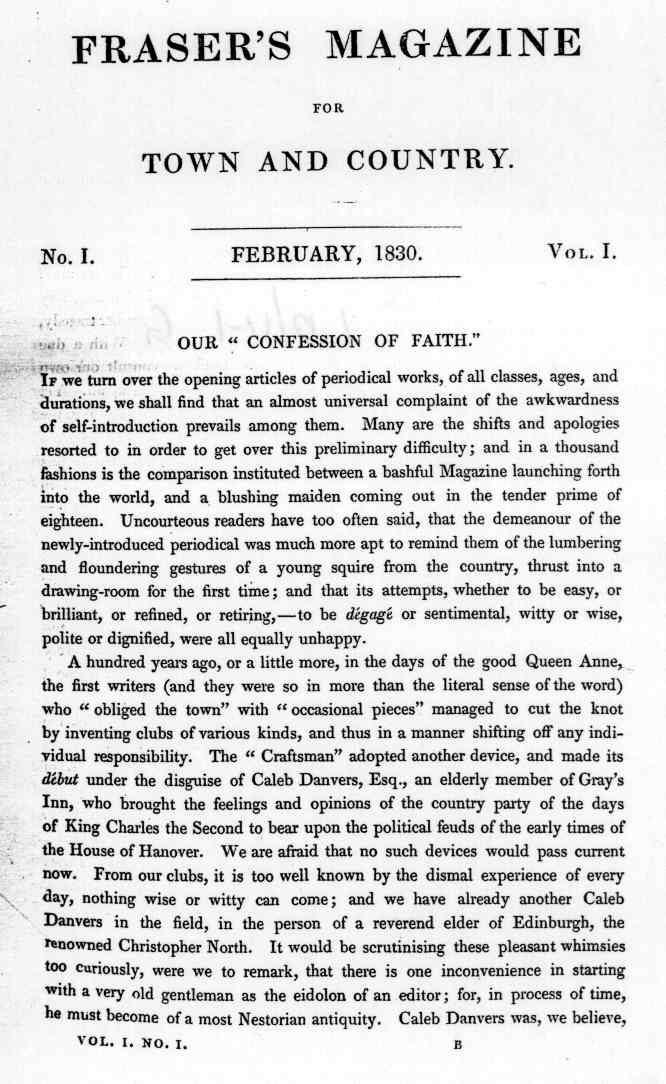
Reproduced by permission, Mitchell Library

Reproduced by permission, the Bodleian Library

image from Google Books
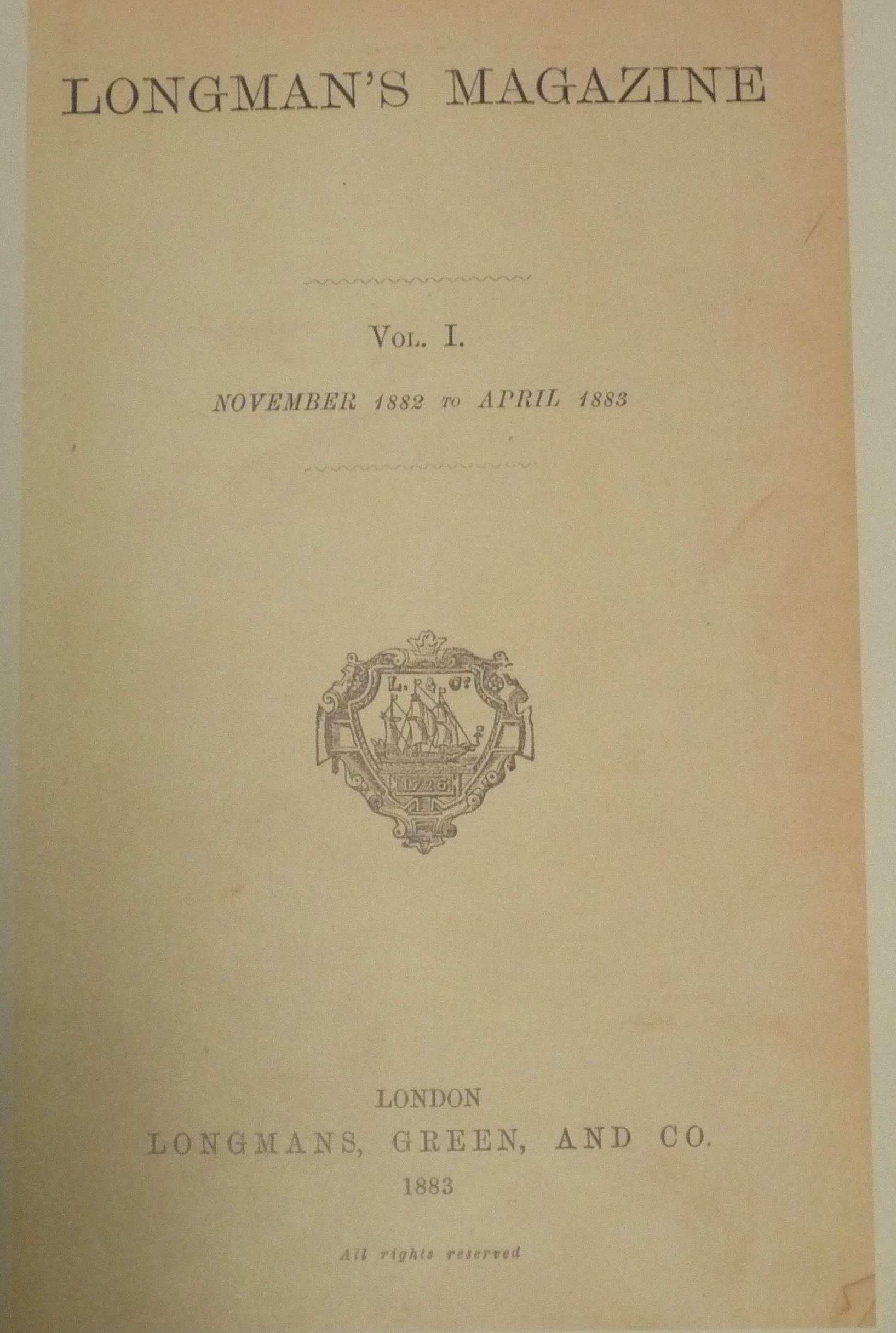
Reproduced by courtesy of Mitchell library, Glasgow City Council
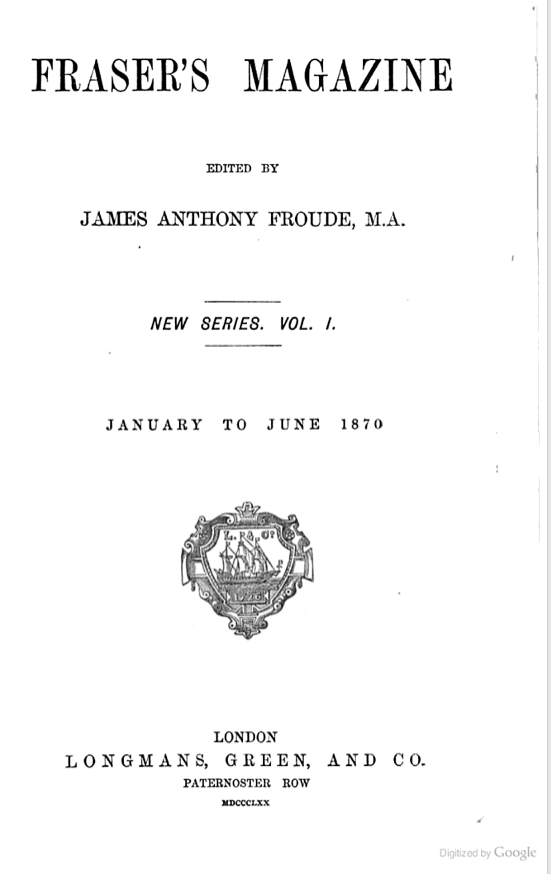
image from Google Books